


Read Time: 4 Min
The Institute of Electrical and Electronics Engineers (IEEE) introduced 10BASE-T1S to support the automotive industry’s transition from legacy networking protocols such as controller area network (CAN) and local interconnect network (LIN). This Ethernet-based standard delivers a streamlined and scalable solution that enables a unified network architecture—simplifying in-vehicle connectivity, reducing system complexity and supporting future scalability.
Key Capabilities of 10BASE-T1S include:
- 10Mbps Ethernet over a single twisted pair
- Multi-drop topologies—multiple nodes sharing a single cable
- Simplified network design and reduced gateway dependency
- Compatibility with both zonal architectures and edge-node integration
These capabilities make 10BASE-T1S a timely and transformative innovation. It aligns with automotive trends toward centralized computing, over-the-air updates and deterministic communication. The supporting cable-and-interconnect infrastructure enhances reliability to time-sensitive ADAS sensor networks while helping engineers reduce wiring complexity, weight and overall system cost.
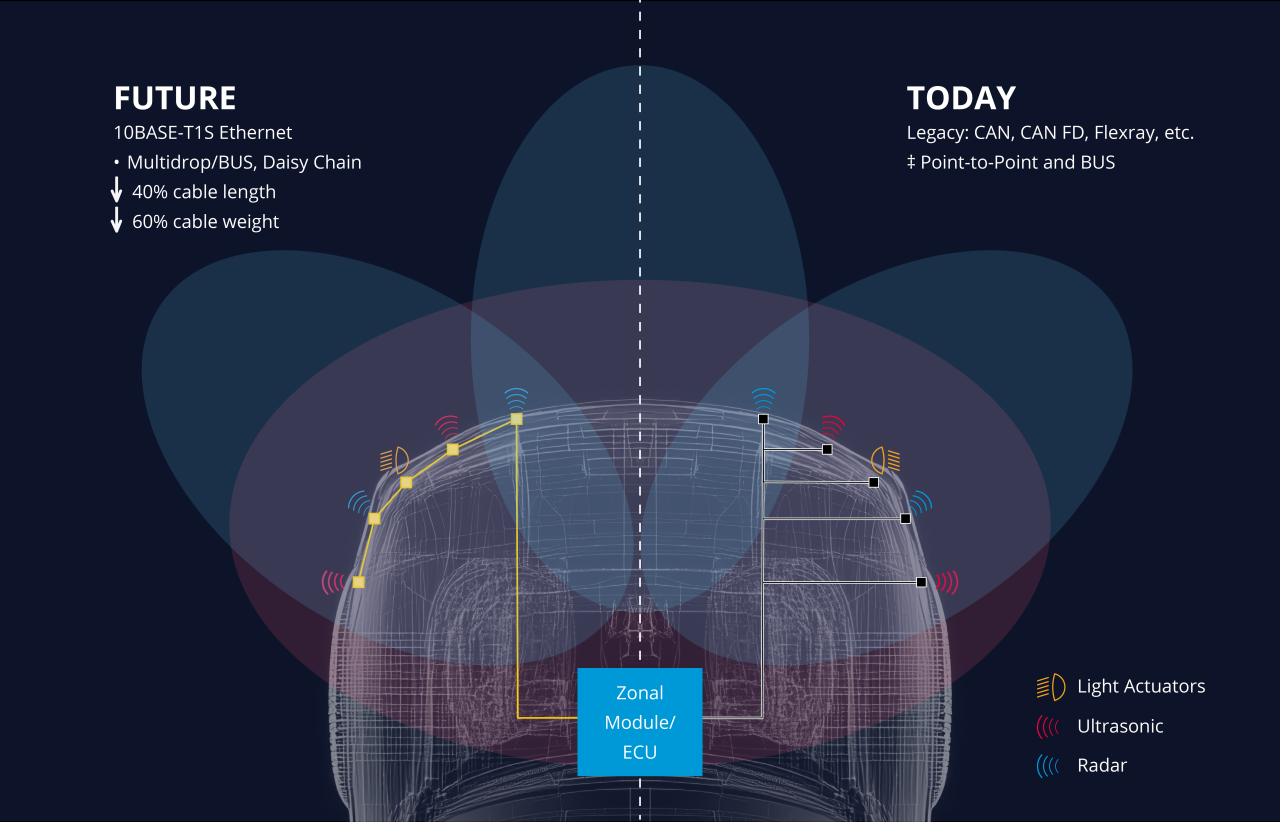
Key Advantages of 10BASE-T1S for Vehicle Network Design
Legacy automotive protocols such as CAN and LIN were never designed to meet the evolving connectivity demands of modern vehicles. Today’s engineers manage increasing electronic control unit (ECU) counts, tighter packaging constraints and the needs for faster, more deterministic communication, especially for systems such as ADAS, infotainment and body control. Existing solutions often rely on complex gateway configurations and protocol translations, which introduce and drive up costs.
10BASE-T1S offers several key advantages that directly address these challenges:
- Reduced Cabling and Connectors: Multi-drop capability allows multiple nodes to share a single twisted-pair cable, significantly reducing total cable length, weight and overall system cost.
- Improved Network Resilience: Unlike point-to-point links, 10BASE-T1S isolates faults so a single node failure does not disrupt the entire network.
- Lower System Weight and Cost: Simplified wiring harnesses and fewer gateways reduce both bill of materials (BOM) and vehicle weight.
- Enhanced Scalability: The solution easily expands within zonal architectures without extensive rework or revalidation.
- Support for Deterministic Communication: PLCA (Physical Layer Collision Avoidance) ensures predictable transmission timing, critical for time-sensitive applications.
- Ethernet Compatibility: 10BASE-T1S seamlessly integrates with existing Ethernet backbones, enabling a unified network protocol across the vehicle.
By simplifying network design while supporting real-time responsiveness, 10BASE-T1S bridges the gap between fragmented legacy communication schemes and the software-defined, Ethernet-based systems expected in next-generation vehicles. For electrical design engineers, adopting 10BASE-T1 represents a strategic step forward.
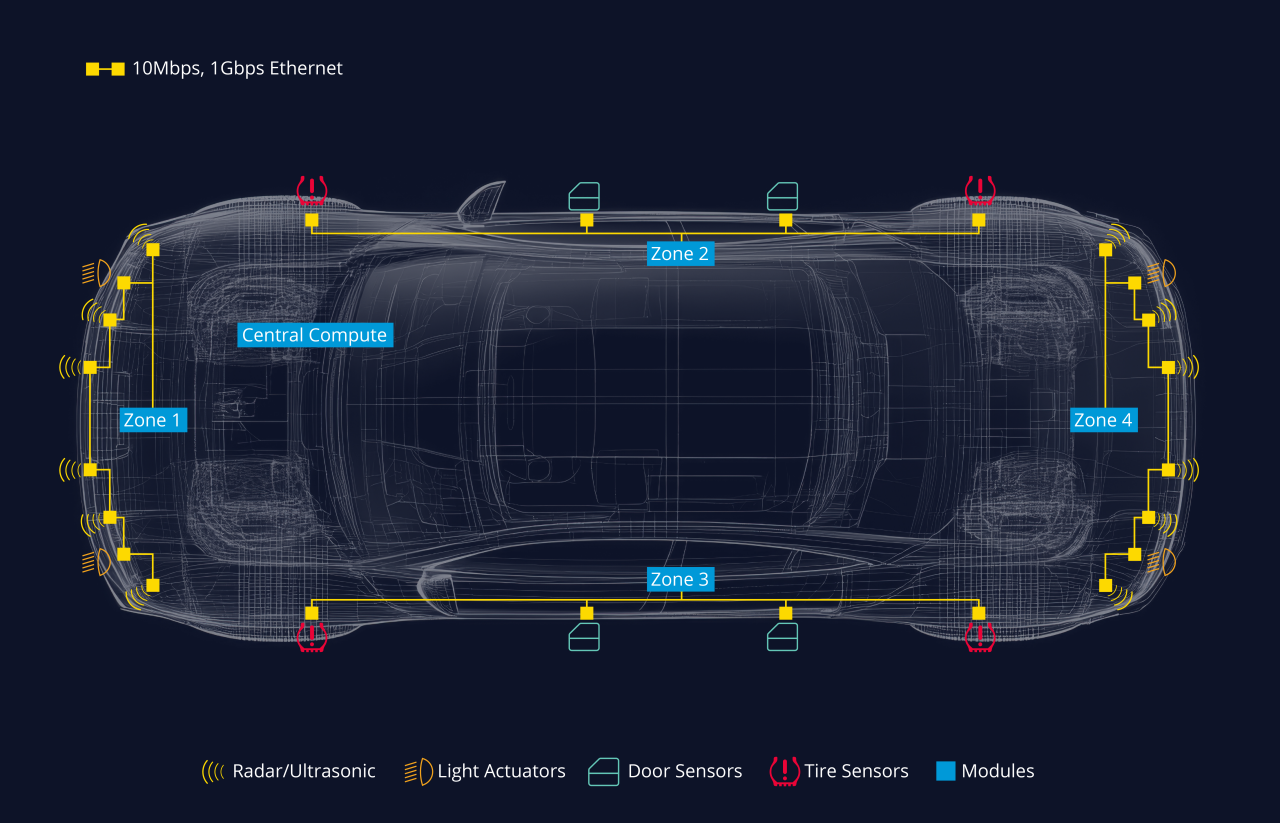
Overcoming Signal Integrity and EMC Challenges
While 10BASE-T1S simplifies network topologies, successful implementation still demands precision in system design, especially when performance and regulatory compliance are on the line. Fortunately, many of the most common signal integrity (SI) and electromagnetic compatibility (EMC) challenges are well understood and increasingly manageable with the right design approach and components.
There are two key focus areas for ensuring robust 10BASE-T1S system behavior.
First, both engineered and off-the-shelf connectors have demonstrated reliable performance at 10BASE-T1S speed. However, to fully leverage multi-drop capabilities, existing systems may require connector-level modifications. Even modest increases in untwist length can cause impedance mismatches, mode conversion and elevated electromagnetic interference (EMI), making precise cable termination and twist management essential for optimal signal quality.
Second, off-the-shelf connectors often lack defined impedance, making them hard to simulate without proper tools and expertise. However, with the right modeling techniques, these configurations can be evaluated with confidence and accuracy.
Rather than posing a barrier, these physical layer considerations offer opportunities to streamline system design and reduce trial-and-error cycles. By applying simulation best practices and proven interconnect strategies, electrical engineers can build with confidence, knowing their 10BASE-T1S implementation is stable, scalable and production-ready.
What It Takes to Unlock the Full Potential of 10BASE-T1S
To make 10BASE-T1S integration easier, faster and more reliable, next-generation hardware must address the nuanced, real-world challenges that electrical design teams face daily. The ideal solution suite should deliver:
- Verified Cable Performance: Comprehensive signal integrity and EMC validation, including time-domain reflectometry (TDR) analysis, ensures precise control of cable untwist and impedance.
- Robust Multiway Connector Modeling: Accurate simulation of complex, non-impedance-controlled connectors anticipates signal path behavior and eliminates guesswork.
- Compact Interconnect Options: Designed to minimize overall package size and cable bulk, these solutions are ideal for space-constrained, daisy-chained configurations.
- System-Level Simulation Fidelity: Hardware that behaves in the lab as it does in simulation reduces iteration cycles and minimizes late-stage surprises.
The Oncoming Wave of Automotive Ethernet
The growing complexity of ADAS and the shift toward software-defined vehicles demand simpler, more scalable network solutions. 10BASE-T1S brings Ethernet closer to the edge, supporting zonal architectures, reducing wiring and laying the foundation for future-ready platforms.
As part of its long-standing investment in Ethernet-based automotive networks, Molex is developing a complete end-to-end solution that fully unlocks the benefits of 10BASE-T1S. This solution leverages patented interconnect technologies proven over two decades in the market, now refined to meet OEM demands for compact, cost-effective and lightweight designs. By combining connector, cable and module-level innovations, Molex enables seamless integration of multi-drop Ethernet architectures—reducing wiring complexity, improving scalability and accelerating the transition to zonal and software-defined vehicle platforms.
Discover how Molex is engineering the next generation of vehicle connectivity and supporting the evolution toward unified Ethernet-based communication. Molex delivers the smallest connector solution for 10BASE-T1S multi-drop architectures, helping OEMs and Tier 1 suppliers streamline integration, reduce system cost and weight and accelerate the transition to zonal and software-defined vehicle platforms.
Explore advanced connectivity solutions for automotive Ethernet.
Share